

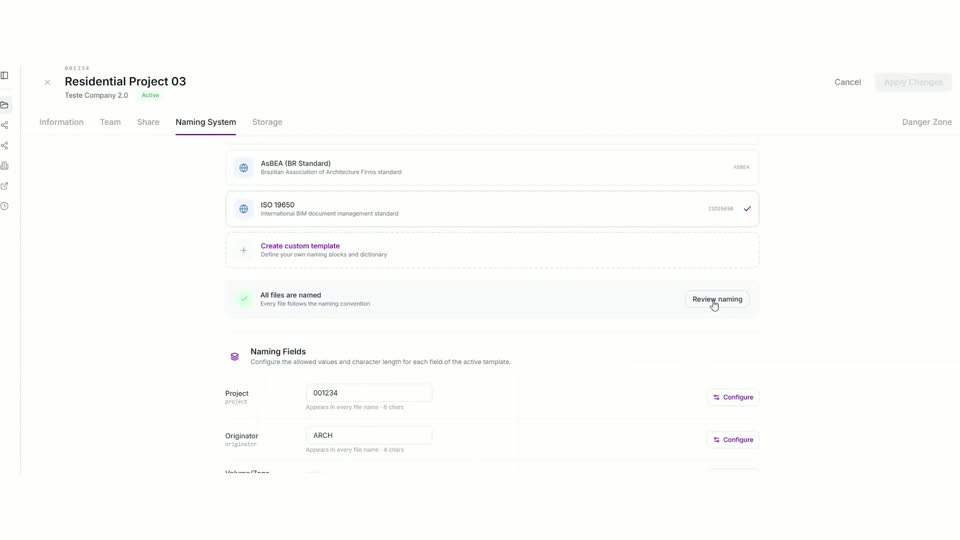
Hub
The home of the project — files, versions and access, all in one place.
ArchG Platform
Six modules, one workflow — plan, execute and measure. Built by architects, for architects.
The pitch
Lean canvas
Everything below this section expands one of these nine boxes. If you only read one thing on this page, read this one.
1Problem
Existing alternatives: Bluebeam, Revizto, MS Project, Clockify, Power BI and BQE at US$ 164–327 per user/month — or Trello, spreadsheets, email and WhatsApp at US$ 10–30.
2Customer segments
Early adopters: multidisciplinary studios in Brazil, Portugal and the EU, where the incumbent's brand weighs less and the purchase decision is driven by usability and price.
3Unique value proposition
4Solution
5Channels
6Revenue streams
7Cost structure
8Key metrics
9Unfair advantage
The problem
The decision is made out loud in a meeting. It is repeated in a WhatsApp audio. The revision travels by email. The hours are logged at the end of the month, or never. None of it is attached to the drawing, the model or the document it changes — so when someone asks why, months later, the discussion starts from zero.
Six or more specialised subscriptions — Bluebeam, Revizto or BIMcollab, MS Project or Primavera, Toggl or Clockify, Power BI, BQE or Deltek.
US$ 164 – 327
per user / month
The predominant case. Generic task tools, spreadsheets, email and chat. The direct cost is low because most of the process is simply not instrumented.
US$ 10 – 30
per user / month
Near zero in several fronts does not mean there is no cost. It means the cost moved to a category nobody counts.
| Current practice | Real cost, uncounted |
|---|---|
| Decision verbalised in a meeting | Where most project decisions actually happen. What matters is said, discussed and adjusted live, and none of it survives in recoverable form. |
| Formal meeting minutes | Bureaucratic enough not to be kept with discipline, and even when it exists it lives apart from the artifact. The decision to change a riser stays in the minutes, not on the sheet it affects. |
| Decision taken in a WhatsApp audio | The decision exists but is not linked to the artifact it changes. When it is questioned months later there is no recoverable record and the discussion restarts. |
| Revision sent by email | The correct version depends on who searched their inbox better. Rework from the wrong version is the direct consequence. |
| Hours not logged, or logged month-end | Without real effort data, the next estimate remains intuition. The studio does not learn from its own history. |
| Issue resolved without a record | The problem is solved but the pattern is never detected. The same kind of clash reappears in the next project and nobody notices the recurrence. |
The framework
Every platform in this market treats a task as a task. ArchG separates planned effort from emergent effort natively — and binds both to the artifact they affect.
The distinction is not a label on a card. It is structural, and it runs through the whole platform: the Kanban, the Gantt, the BIM issue pins, the PDF markups and the time log. No tool in this market separates planned from emergent effort this way — which is why a studio using ArchG can finally see the real composition of its own work, and calibrate the next estimate with its own data.
The platform
Files, planning, time, annotations, model and performance — all connected to the same project. Every screen below is the real product.
The home of the project — files, versions and access, all in one place.
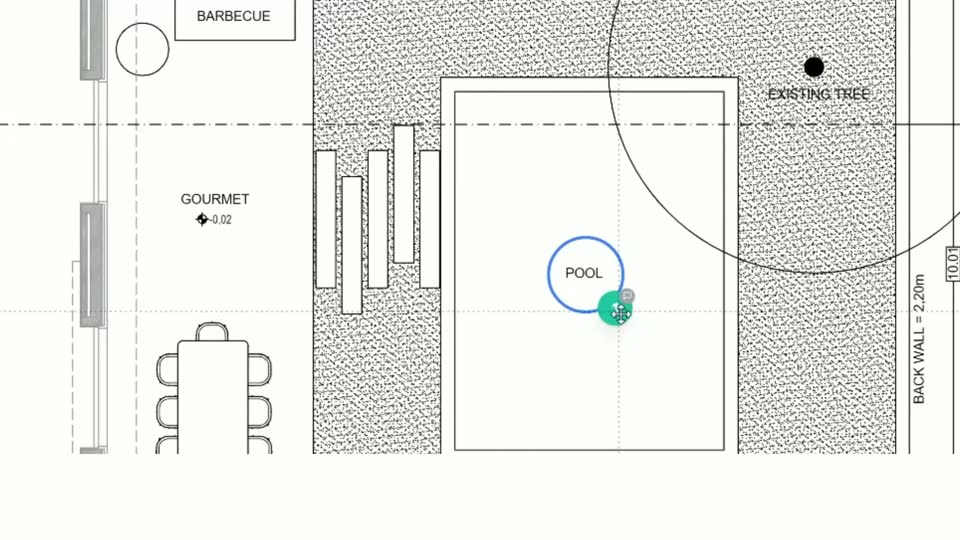
Markups on PDFs and drawings — every note is a real project task.
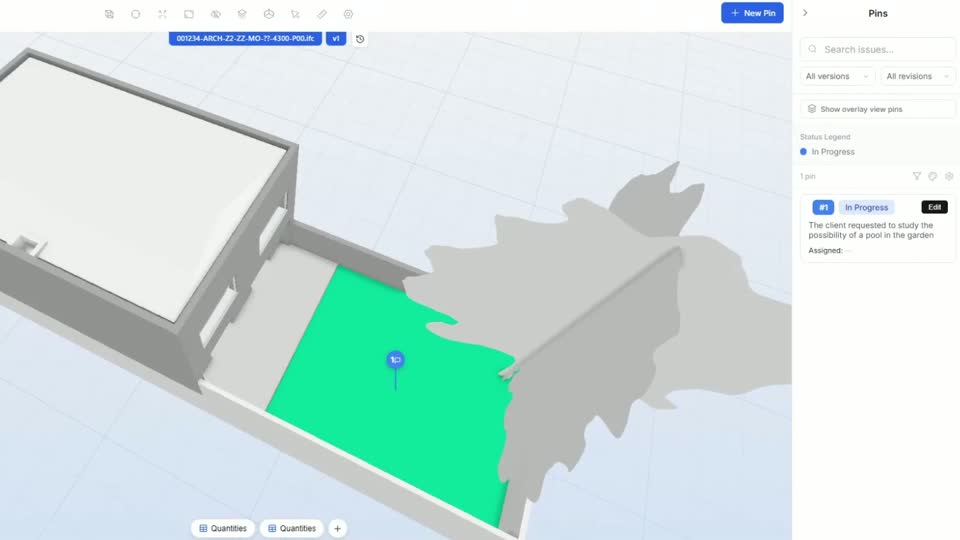
Issues, coordination and quantity take-off right in the IFC model.
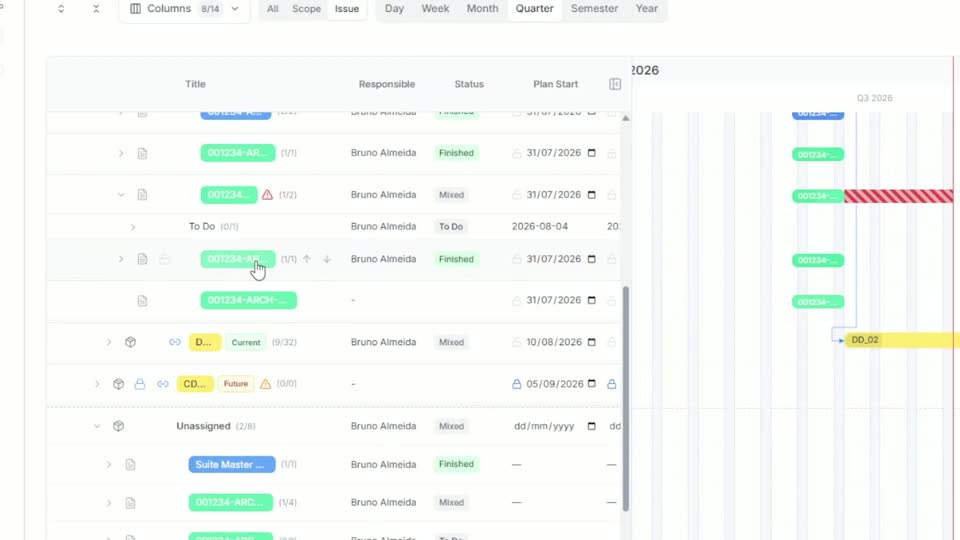
From document to task — scope, deadlines and planning in one place.
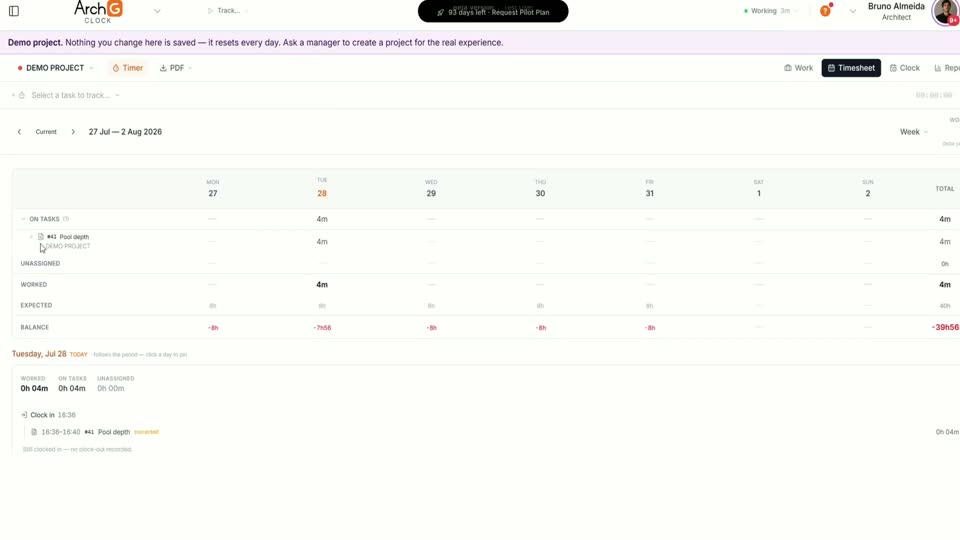
Logged time, attendance and productivity, in real time.
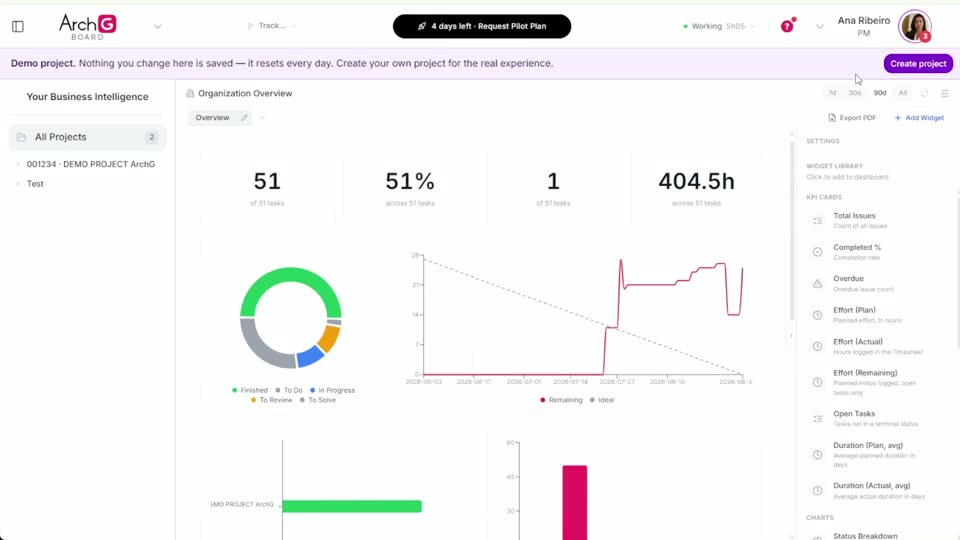
Custom dashboards — KPIs and charts by organisation, portfolio or project.
Your files stay in the Drive or the S3 bucket your company already uses. Nothing to migrate, GDPR compliance preserved — and if the platform ever stops existing, the data does not disappear with it.
Revit and Archicad add-ins, and solid IFC support — the model is read where it is authored, not re-created.
Browse by portfolio, Shared, Official and Main · Create, import, move and version files · Folder-level access control · Publish to WIP and Official Revision
Annotations anchored to PDFs and drawings · Measurement, layers, crop and overlays · Drawing and text tools · Every note is a task with an assignee and chat · Sketchbook
Model overlays with opacity · Isolate, X-Ray and section box by level · Length, area and elevation measurement · Issue pins with clash detection · Quantities with cost and Price Book
MDR — master document register · Scope Control — scope and effort tree · WBS by scope or deliverable · Gantt Chart — schedule and dependencies · Kanban
Work — tasks with a timer · Timesheet — weekly log by task · Clock — attendance, schedule and overtime · Report — team productivity and efficiency
KPIs — total, completed, overdue, effort · Charts — status, burndown, workload · Tables — summary by status and by member · Dashboards by organisation, portfolio or project
The data layer
Because the work itself happens inside the platform — every file version, markup, issue, task and logged hour — the operational data is captured at the moment it occurs, in the natural flow of the process. No status reports, no parallel spreadsheets, nobody chasing anybody for an update.
Granular operational control, with zero reporting overhead. Today that makes a studio legible to itself. The same data is what makes the next product possible.
Phase 2 — not shipped yet
There is no AI in the product today, native or integrated. What is planned for the official launch is a native model running on ArchG's own infrastructure plus an MCP bridge, so a client can use its own model and its own agent. In a market where the alternative is sending project content to a third party's cloud, that is a competitive position and not only a technical choice — and the quality of any such layer depends on the record that feeds it, which is exactly the granular scope and issue data described above.
In evaluation
The professionals below are evaluating the product and speak from that use. They are not customers, and none of them has a commercial commitment with ArchG.
“For the team, the main thing is that they don't have to use several pieces of software, several platforms — it is all gathered in one place. And that changes the game, because today we keep jumping from one side to the other.”

“Sometimes it even brings answers to problems we didn't even know how to solve. I found it really complete — there's a lot in there.”

“I used to navigate between Clockify, between Trello, between Miro itself, just to get through my day. And I had to reconcile all of that in my own head. One single place where you see all of it — we're already talking about a tool that helps us organise and save time.”

“What you get is efficiency. It's time saved — because everything you don't want in project development is rework, is loss of information. And I think your tool lets you avoid those losses along the way. And that's at any level.”
Three further studios are testing the platform and are not named here.
Market
The dominant vector in this market is not technological, it is regulatory. BIM mandates in public procurement and urban licensing turn voluntary adoption into a legal requirement, on dates that are already published.
| Vector | Horizon | Effect on demand |
|---|---|---|
| PortugalBIM — RCM 89/2026 | May 2026 | National BIM implementation strategy. Municipalities adopt BIM for urban licensing; public bodies prepare procurement integration. |
| RJUE — BIM modelling mandatory | 01.01.2030 | Architecture projects in scope must be modelled in BIM. Converts voluntary adoption into a legal requirement, on a known date. |
| Decreto-Lei 10/2024 (SIMPLEX) | In force | Dematerialisation of urban planning processes and delivery requirements in public procurement. Pressures digital process in the short term. |
| BIM mandates across Europe | 35% of countries | United Kingdom since 2016, Czech Republic from 2027. Directive 2014/24/EU already allows member states to require BIM in public contracts. |
| Estratégia BIM BR | Under way | Federal programme for BIM adoption in Brazilian public works. The national equivalent of the same regulatory vector. |
| Headwind — European workload | Next 12 months | 37% of European architects expect less work against 19% expecting more. May delay discretionary purchase decisions. |
Brazil
TAM · 28,382 studios
R$ 511 M
SAM · 9,934 studios
R$ 179 M
Europe
TAM · 186,000 potential users
€ 190 M
SAM · 74,400 potential users
€ 76 M
Europe is roughly twice Brazil in value on a similar user base. The difference comes entirely from the practicable price, not from the size of the base.
A TAM is the product of several estimates multiplied together, and the result looks more precise than it is. Every premise below is a declared choice, not a measurement. Replace one and the result changes.
| Premise | Value | Basis and fragility | |
|---|---|---|---|
| A | Registered studios actually in operation | 60% | Registration with CAU does not imply activity. Dormant companies and one-partner micro firms inflate the base. No public data; conservative premise. |
| B | Operating studios with a team of three or more | 35% | The product adds little for the lone professional. The ACE Sector Study measures close to 70% solo practices in Europe, implying about 30% with a team. The Brazilian figure remains unmeasured — and this is the variable with the largest impact. |
| C | Average licensed users per studio | 6 | Not total headcount: it counts who would actually use the platform. Based on the typical size of a mid-sized Brazilian studio. To be replaced by real data once the pilots are running. |
| D | Share of the SAM with real ICP fit | 40% | Filters for multidisciplinary studios, or those coordinating across specialities, where the pain is acute. Qualitative inference. |
| E | Average price per user / month (Phase 2, Brazil) | R$ 250 | A deliberately conservative choice, set below the Phase 2 Brazilian range of R$ 220–420 defined in the pricing benchmark. |
| F | Realistic SOM capture over three years | 2% | Reflects an operation in validation, with no commercial team. It is a base case, not a target — about 79 client studios, or R$ 1.4 M. |
Sensitivity: premise B moves the result more than any other. At 25% the SAM falls to about R$ 128 M; at 45% it rises to about R$ 230 M. A single unmeasured premise produces a spread of more than R$ 100 M — which is why no number here should be presented without the premise that generated it.
Declared gaps: no consolidated count of engineering firms in Brazil (Confea/Crea does not publish one), so the TAM here is understated; no count of architecture firms in Portugal (the Ordem dos Arquitectos directory requires authentication); and no willingness-to-pay figure has been commercially validated to date.
Where we are
We are in market validation, collecting structured feedback from real use. The barrier is not belief in the product — the studios testing it say what they say above. The barrier is implementation and habit. In an AEC office time is the scarcest resource, and nobody can afford to feel they are wasting it on a tool that has not proved itself yet.
The distance between R$ 511 M of TAM and R$ 70 k of projected annual revenue is not a contradiction. It is the most useful piece of information here: the constraint on this business today is not the size of the market, it is the capacity to reach it.
| Funnel stage | Value | Note |
|---|---|---|
| Studios researched and approached per week | 10 | Compatible with 1 to 5 hours a week for marketing and sales. |
| Approaches per month | 40 | With no dedicated commercial team. |
| Response rate | 15% | Six conversations started per month. |
| Conversation to demo | 50% | Three demos per month. |
| Demo to client | 20% | Fewer than one new client per month. |
| Clients in twelve months | about 7 | Between 40 and 45 users, at pilot price — R$ 65 to 75 k a year. |
Reaching 25 studios in twelve months means about 140 approaches a month at the same conversion rates — three and a half times the current reach, which is one full-time commercial person. And if accompanied onboarding lifts demo-to-client from 20% to 30%, the requirement drops to about 93 approaches a month: the customer success role paying for itself, against the exact barrier named above.
Monetisation
Consolidation does not sell to a studio spending US$ 10 a month — there is no stack to consolidate. For that segment the sale is about what is already being lost. For the equipped studio, it is about replacing the whole stack for a fraction of the cost.
| Reference | Price / user / month | Reading for ArchG |
|---|---|---|
| Autodesk Forma (ex-Construction Cloud) | US$ 125 – 200+ | Strong in BIM and documentation, weak in financial management. Sustained by brand, ecosystem, existing corporate contracts and an AI-native strategy. |
| BQE Core / Deltek Ajera | US$ 30 – 75 | Strong in finance and project accounting, weak in BIM and markup. The inverted mirror of Forma. |
| Revizto / BIMcollab | US$ 60 – 90 | Cover BIM coordination only. ArchG delivers that plus the remaining fronts. |
| MS Project | US$ 30 – 55 | Seen by users as replaceable by ArchG. Covers scheduling only. |
| Procore / Oracle Aconex | Quoted, thousands/month | Focused on site and large contracts. Not direct competition in the design process. |
| Trello / ClickUp / Notion / Asana | US$ 0 – 25 | Generic, not built for the sector. They define the reference spend of the informal studio, not the value delivered. |
The incumbent's advantage is not the product in isolation: Autodesk owns the tools where the project is actually authored, which guarantees native interoperability that cannot be replicated. The mitigations available are real but partial — Revit and Archicad add-ins with solid IFC support, no implementation cost, a low entry price, and Bring Your Own Storage, which turns the most expensive objection in a challenger sale, vendor continuity and data ownership, into an argument in favour.
Founder

Founder · ArchG Platform
ARCHITECT | PMP® | PMO-CP® | MBA
Architect, thirteen years in the field. Worked at large practices in São Paulo, including multinationals. The last eight of those years were spent mainly in project management and operations — which is where ArchG comes from. It was not designed from a market study; it was built from the process the founder was running by hand.
linkedin.com/in/omarcelooliveiraThe ask
€ 250,000
for 12 months of runway.
A lean structure of four people, the founder included: one full-stack developer, so the founder stops being the bottleneck on product and the Phase 2 triggers actually ship; one commercial hire, for the reach the funnel needs; and one onboarding and customer success role at half time rising to full, so implementation is free and accompanied — removing the friction without discounting the licence.
25 paying studios — churn under 5%, NPS above +45, and B2B collaboration, the financial module and the AI layer in production. Those 25 are exactly the founding-member cohort the pricing plan caps at 20 to 30 accounts.
Which is why the investment does not buy revenue. Those 25 accounts keep their price for life, by design. What the investment buys is the closed and measured founding cohort — and with it the references, the NPS, the case studies and the real usage data that replace the weakest premise in the model — plus the commercial machine that will sell Phase 2, at US$ 79–119, to everyone who comes after them.
Declared premise: salary costs assume remote hiring at Brazil / Portugal rates. It is the single variable that moves this budget most.